The Final Inch
The work is almost completed. In that moment of fatigue...it is especially tempting to leave the work.
The Rule of the Final Inch consists in this: Not to shirk this critical work, not to postpone it... one's purpose lies not in completing things faster, but in the attainment of perfection.
- Alexander Solzhenitsyn
Thus starts an HBO Documentary Film that tells us of current efforts to eradicate polio world wide. In the background we hear sharp distant chords that increase in volume while vivid images of urban India appear on the screen.
The film continues in silent-movie fashion telling us in text that fades in and out
The polio virus has been eliminated from the developed world. A vaccine has existed for more that 50 years, but in some countries the virus hangs on. In 1988, the World Health Assembly launched an initiative to wipe out polio wherever it remained. Every government in the world signed on. Today, a quiet army fights the disease in some of the world's most vulnerable places. This is the story of a few men and women in that army.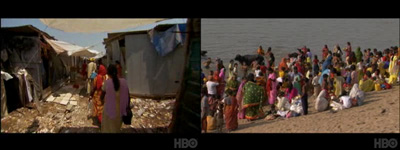
The first portion of the movie was filmed in the State of Uttar Pradesh in India which has a population of 187 million (more than half the population of the United States in a land area roughly the same size as Oregon). Uttar Pradesh has the unfortunate distinction of having the world's highest concentration of polio infection.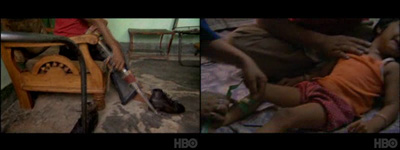
The film continues by showing us people young and old who suffer from polio. It chronicles the work of a young woman named Munzareen. She is a Community Mobilizer for UNICEF (the United Nations International Children's Emergency Fund or more simply the United Nations Children's Fund). While an important part of her job is visiting 446 houses every month to make sure every child is vaccinated, perhaps more important is her job of educating the people she visits. This education consists of the importance of clean water and cleanliness. She keeps track of her visits with a large spreadsheet like binder noting the vaccines given and those that are refused.Since polio still occurs in this State, many local people do not trust the vaccine and therefore refuse treatment for their children. During meetings of local leaders some also complain loudly about the poor sanitation provided by the State and the abundance of garbage that is also ignored by the State, both of which contribute the spread of the disease.
Munzareen also visited the local schools encouraging the children there to come to the polio booths set up around town to receive their vaccination. It is heart warming to see the enthusiasm of the children as she leads them in chants of 'Two drops -- for a life!'. She also asks, 'What should you do before you eat your food?' to which the students reply in unison 'Wash our hands!' She then goes on to explain why it is so important to wash your hands before eating.
Again, the silent movie text tells us:
4 million people work to eradicate polio in IndiaAn organization larger that any army in historyNext the movie shows M.S. Jain the District Governor for Rotary District 3100 getting ready to participate in the local polio vaccination day. He has whistles and other fun items to give the children after they receive their two drops. All this helps encourage participation in the vaccination program.
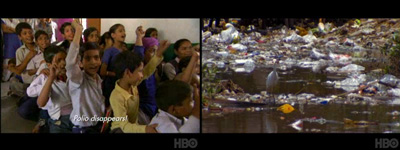
While the movie did show scenes of enthusiastic children in clean schools, it also showed, in graphic detail, some of the filthy and deplorable living conditions that still exist in parts of India. This helped drive home an understanding of why polio continues to be a problem for India.Our own Wendy Davis who has been to India on polio eradication service trips on behalf of Rotary International made a few comments at the end of our meeting. She mentioned how this film did an excellent job of accurately portraying the conditions in India.